|
What is it? |
| |
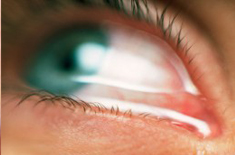
Red itchy watering eyes can
often be due to eye allergy. Eye allergy is a
abnormal response to any organic or chemical agent
present in the air or somehow coming in contact with
the eye. |
|
What Causes it? |
| |
A person can develop allergy
to just about any chemical or organic agent.
Interestingly there can be allergy to even
anti-allergy medicines.
The tendency for allergy is an inherent trait of a
person and may have some genetic basis. People who
are prone to allergies usually have multiple
allergies. |
|
Who are at risk? |
| |
Allergy is seen more
commonly in children or young adults who have an (hyper)active
immune system. People borne of parents who have
allergies are at greater risk and so are individuals
living or working in environments where they are
exposed to chemical fumes or organic dust.
Some specific types of eye allergies are more common
in young boys aged 5 to 15 years viz. Vernal Catarrh
or Conjunctivitis and some may occur in people who
harbor some infections in the body. |
|
What are the symptoms & signs? |
| |
Redness, itching & watering
are typical symptoms of eye allergy. These symptoms
may be accompanied by episodes of sneezing, slight
fever, breathlessness or skin allergies. Occurrence
of allergy is always preceded by exposure to
allergen (the agent causing allergy), so it may be
more common in a particular season or a particular
environment. In Vernal Conjunctivitis the symptoms
are more common in summer months and patient feels
better in winter months.
The eyes appear red and may be slightly swollen.
Prolonged recurrent allergy can lead to dropping of
upper eyelids giving a sleepy appearance. There can
be stringy or ropy discharge from the eye and there
could be formation of a whitish ring on cornea
(black of the eye).
The vision is usually not affected by allergy. |
|
How is it diagnosed? |
| |
Eye allergy can be easily
diagnosed by its symptoms and a typical history, and
by detailed eye examination which reveals the
characteristic signs. However, finding out the exact
cause or agent giving rise to allergy may not be
easy unless an observant patient is able to relate
the symptoms to specific agent or one may have to
conduct a battery of sensitivity tests with not so
rewarding results. |
|
What is the treatment? |
| |
The treatment may include
some or all of the following depending on the
severity of clinical situation:
1. Avoidance of the agent causing allergy or
allergen – this is the single most important step in
the management of allergy. But identifying and
avoiding allergen may not always be possible. In
such situations one has to wait for the allergy to
die out on it own.
2. Anti-allergic eye drops and sometimes oral
anti-allergic tablets.
3. Mast-cell Stabilizing drugs as eye drops are used
to prevent recurrence of seasonal allergy
4. Steroid eye drops may be required in severe cases
as a short course to control the disease
5. Desensitization is possible in some cases where a
specific allergen can be identified and isolated. |
|
What are the surgical options? |
| |
Surgery is rarely required
for eye allergy. One of the indication for surgery
is development of extremely large cauliflower
papillae in severe cases of Vernal Conjunctivitis.
These giant papillae may require removal / excision
by surgery. |
|
What are the outcomes? |
| |
Allergy usually dies out
naturally over a period of 3-4 years; however, in
some cases it may trouble life long. It can be
easily controlled with use of appropriate drugs. |
|
What are the complications? |
| |
Complications caused by
allergy itself are uncommon but are usually caused
by the side-effects of the drugs used for its
treatment. Prolonged use of steroids as required in
very severe cases can lead to development of
glaucoma and cataract. Vernal conjunctivitis cases
can develop dropping of eyelids (Ptosis) and a ring
like opacity in peripheral cornea (Cupid’s Bow). |
|
What is the time course? |
| |
In majority of cases the
allergy can be easily controlled in 1-2 weeks time.
But drug treatment may be required for a few weeks
to months to maintain a certain level of comfort. In
most cases the allergy lasts 3-4 years. |
|
What is the expense? |
| |
The treatment for a given
episode of allergy is not expensive. However,
recurrent episodes of allergy over the years and
especially the management of any of the
complications can add up to a significant cost.
The patients of recurrent allergy should work in
partnership with the Eye Surgeon to manage their
disease. |